 Skip to content

Area Rug and Oriental Rug Cleaning in Santa Monica, CA
AAA 1 Carpet Care cleans oriental and area rugs for households and businesses in Santa Monica, California. A rug is not a carpet with the edges cut off — it is a separate textile with its own construction, its own dyes and its own fringe, and we treat it as its own service rather than as a patch of floor to run a carpet wand over. That applies to hand-knotted oriental and antique pieces, to wool and silk, and to the machine-made area rugs and runners that take the real traffic in most homes. Send the form on this page with the size and the type of rug and we will tell you what is involved.
WHY A RUG IS NOT A CARPET
A fitted carpet is fixed to the floor, so it can only be cleaned from the top. A rug is loose, which means soil falls through the pile and collects on the underside and on the floor beneath it, where nobody sees it. Cleaning a rug only from the top leaves that layer exactly where it is. It also means rugs can be treated on both faces, which is the whole reason they clean up better than fitted carpet when the job is done properly.
Construction matters just as much. A hand-knotted oriental rug has dyes that can migrate if it is over-wetted, a foundation that reacts to moisture, and a fringe that is part of the structure rather than a trim. An antique piece may have been repaired or rewoven in places. A machine-made rug with a latex backing has an entirely different weakness: too much water can break the backing down. None of those behave like a nylon carpet.
WHAT THE COAST DOES TO A WOOL RUG
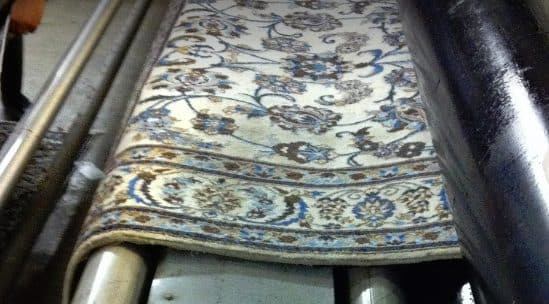
Wool is the fibre most oriental rugs are built from, and wool is hygroscopic — it absorbs moisture out of the air and holds it. In Santa Monica, where the marine layer keeps humidity up for much of the morning, that means a wool rug is rarely completely dry. Damp wool is heavier, it releases soil less readily, and over a long period it is a friendlier environment for odour and for moth activity than a dry one, particularly in a rug that is rolled up and stored.
Sand is the other half of the story. It travels indoors from the beach and it drops straight through an open pile to the foundation, where it sits against the knots. Because a rug is loose, that grit has nowhere to go, and every footstep grinds it against the base of the wool. A rug that feels gritty when you press into it is already being cut from underneath, and no amount of surface vacuuming reaches it.
HOW WE APPROACH A RUG
We identify what the rug is first — fibre, construction, whether it is hand-knotted or machine-made, whether the dyes are stable. A colour-fastness test on a hidden area comes before anything wet, because dye migration in an oriental rug is not something that can be undone afterwards. Fringes are inspected separately, since they take the worst of the wear and are the part most often damaged by aggressive cleaning.
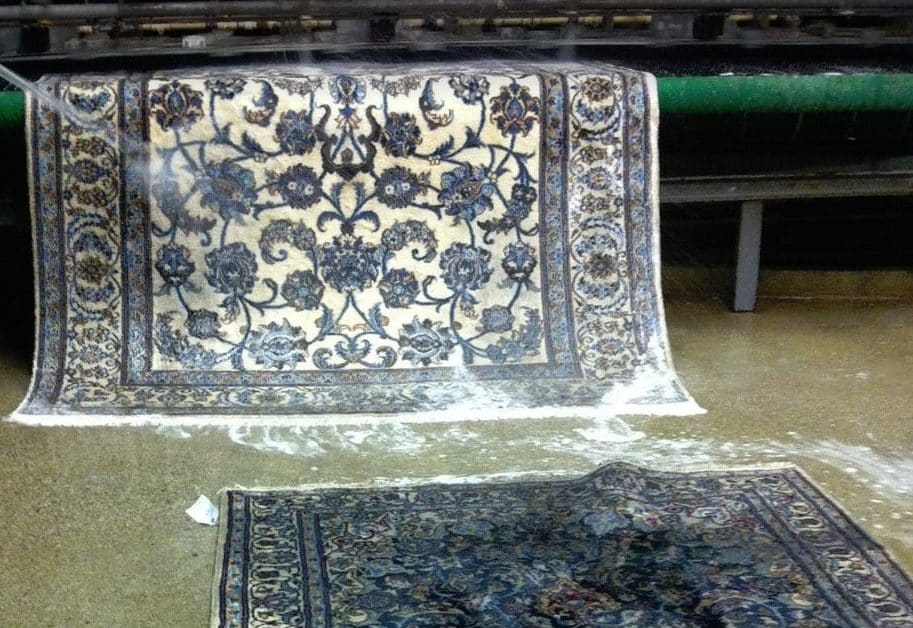
Dry soil comes out first and thoroughly, because that is the step that protects the fibre. Cleaning is then matched to what the rug will accept, with moisture and agitation kept to what the construction can take, followed by careful drying. Rugs left damp develop odour and can wick soil back up into the pile, so drying is treated as part of the job rather than as something that happens on its own.
RUG TYPES AND WHAT EACH ONE NEEDS
These are the rug types AAA 1 Carpet Care states it works with. The differences below are why one method does not suit all of them.
| Rug type | How it is built | What that means for cleaning |
|---|---|---|
| Hand-knotted oriental | Wool or silk pile knotted onto a cotton or wool foundation | Dyes tested first, moisture controlled, fringe handled separately |
| Antique or rare piece | Aged fibre, often with old repairs or reweaving | Inspected before anything else, cleaned as gently as it allows |
| Wool area rug | Absorbent natural fibre, usually machine woven | Cleans well but must be dried properly or odour returns |
| Silk or silk blend | Fine, lustrous, easily marked by water | The driest method the rug will take, tested beforehand |
| Machine-made with latex backing | Synthetic pile bonded to a backing layer | Over-wetting breaks the backing down, so water is limited |
| Flat-weave or kilim | No pile, so soil sits in and passes through the weave | Both faces need attention, not just the side you walk on |
WHAT WE NEED TO KNOW FROM YOU
The useful things to tell us are the size, roughly what the rug is made of if you know, whether it is hand-knotted or machine-made, and where in the house it sits. If it is an inherited or bought antique, say so, because that changes how we handle it from the first minute. Photographs of the pile, the back and the fringe tell us more than a description does.
Also tell us about anything that has happened to it — a pet accident, a spill, a leak, or a previous cleaning that left it looking different afterwards. Pet urine in particular soaks through to the foundation and is a different problem from a surface stain, and it is dealt with as pet stain and odor removal rather than as ordinary rug cleaning.
SANTA MONICA RUG CLEANING FAQS
Can my oriental rug just be cleaned in place with the carpet?
That is exactly what we would advise against, and our own guidance on the subject says the same. A rug has a back and an underside that in-place carpet cleaning never reaches, and hand-knotted dyes and foundations react to moisture in ways a fitted carpet does not. It is treated as its own service, with its own method.
My wool rug smells damp even in summer. What is happening?
Wool draws moisture out of the air and holds onto it, and on the coast the air holds a lot of moisture for much of the day. A rug that never fully dries develops odour in the pile and the foundation. Cleaning removes the soil the odour feeds on, and controlled drying afterwards is the part that stops it coming back.
Is the fringe cleaned as well as the rug?
The fringe is looked at separately because it is structural rather than decorative on a hand-knotted rug, and it takes the heaviest wear. It also soils differently, since it lies flat against the floor. Aggressive cleaning is what shortens and frays a fringe, so it is handled with more care than the field of the rug.
How can I tell whether my rug is hand-knotted or machine-made?
Turn it over. On a hand-knotted rug the pattern on the back is as clear as the pattern on the front and the knots are slightly irregular. A machine-made rug usually has a backing layer covering the weave, and the pattern on the reverse is faint or absent. If you are unsure, send us a photograph of the back.
We found moth damage in a rug that was rolled up in storage. Can it be cleaned?
It can be cleaned, but cleaning does not restore missing pile — damage that has already been done is done. What cleaning achieves is removing the soil and residue that attracted the problem in the first place, which matters before a rug goes back into storage. Tell us what you have found so we can look at the extent of it.
Do you clean rugs for businesses and short-term rentals?
Yes. Entrance runners, lobby rugs and the area rugs in furnished rentals near the beach take heavy, gritty traffic and they are exactly the kind of piece that benefits from proper cleaning rather than surface work. Commercial cleaning is one of our services, so raise scheduling when you contact us.
More from AAA 1 Carpet Care: our oriental and area rug cleaning page explains the service in full, and see also carpet cleaning in Santa Monica, furniture and upholstery cleaning, pet stain and odor removal and wood floor cleaning for the floor underneath.
Request Rug Cleaning in Santa Monica
Send us the size, the type and a photograph of the back of the rug if you can. Use the form below and we will come back to you.